
Osage County Arrest Records and Court Charges
An arrest record is the record of the arrest itself. It captures who made the arrest, the arresting agency, the booking date and time, and the offenses the deputy or officer listed at the jail. In Osage County the Sheriff's Office books people into the county jail in Pawhuska, and the live custody roster shows names, photos, booking dates, and a charges list. That booking list is the first place charges appear, but it is not the formal court charge. The arrest is the event; the charge is what the state decides to prove.
The court charge record begins when the prosecutor acts. The Osage County District Attorney files charges for the State of Oklahoma with the Court Clerk, and those filed counts become part of the District Court case. Court charges after arrest can differ from the jail booking list because the District Attorney reviews the facts before filing. For the custody and booking side of an arrest, the jail roster is covered on the Osage County inmate records page. For the full case file with pleas, disposition, and sentence, see the criminal court records page.
How to Find Osage County Arrest Records and Charges
Filed charges live in the District Court case, so the main search tools are the statewide court systems. On Demand Court Records and the Oklahoma State Courts Network both let the public read Osage County dockets where charges and charge status appear. Booking-side arrest detail stays on the Sheriff's jail roster instead. The two systems answer different questions, so it helps to check both.
- Open the ODCR court records search and choose the court group for Oklahoma District Courts.
- Select Osage in the court dropdown, then search by party name in Last, First format or by full case number.
- Open the matching case and read the charge list, where each count is described and coded.
- Check each charge for its statute code, severity level, and current status such as pending, amended, or dismissed.
If the ODCR result is thin or the case is old, the OSCN docket system offers a second statewide view, including daily docket and county filing reports. The OSCN search page sometimes shows a human verification screen. When it does not load, ODCR or a call to the Court Clerk at 918-287-4104 is the fallback. Felony cases carry a CF prefix and misdemeanors carry CM, which makes case numbers easier to recognize.
Who Files the Charges After an Arrest
An arrest does not set the charges in stone. The Osage County District Attorney's Office, part of Oklahoma District 10, reviews each case and decides what to file. District Attorney Mike Fisher serves both Osage and Pawnee counties. The office prosecutes criminal cases for the State of Oklahoma, supports victims, and handles juvenile and special prosecutions including domestic violence and drug offenses.
Because the prosecutor reviews the facts first, the filed counts can be more, fewer, or different from the offenses listed at booking. A charge may be added, dropped, or swapped for a different statute before the first court date. The District 10 page confirms the office covers Osage and lists where case payments are handled. Once charges are filed, they become part of the public District Court record kept by the Court Clerk.
How Charges Get Filed: Complaint, Information, and Indictment
The charge record starts when the prosecutor files a charging document with the court. The arrest and booking come first, then the state puts the formal accusation in writing. Oklahoma uses three main charging documents, and the one chosen often signals how serious the offense is.
| Complaint | Information | Indictment | |
|---|---|---|---|
| Filed By | Officer / Prosecutor | Prosecutor | Grand Jury |
| Common For | Misdemeanors | Many felonies | Serious felonies |
| Starts | The case | The case | The case |
The Information is the workhorse charging document in many Oklahoma criminal cases. A grand jury Indictment is less common at the county level and is reserved for serious matters. Each document names the defendant, lists the counts, and cites the statute the state says was broken.
Charge Status and What It Means
Charges are not fixed once filed. As a case moves, counts can be amended, reduced, added, dropped, or dismissed. The docket records each change, so the status next to a charge tells you where it stands today rather than where it started. Reading status correctly keeps a reader from assuming a dropped count is still active.
| Status | What It Means |
|---|---|
| Pending | The charge is filed and the case is still open with no final outcome yet. |
| Amended / Reduced | The prosecutor changed the charge, lowered its level, or cited a different statute. |
| Dismissed | The court ended the charge; with prejudice blocks refiling, without prejudice may allow it. |
| Nolle Prosequi | The prosecutor formally declined to pursue the charge. |
Bond is often set once charges are filed, and the docket may show a bond amount tied to the case. The Sheriff's office posts a registered bondsmen list with rules for posting bail in Osage County.
View the Osage County registered bondsmen page to see the bail-bond filing requirements that apply after charges are filed.
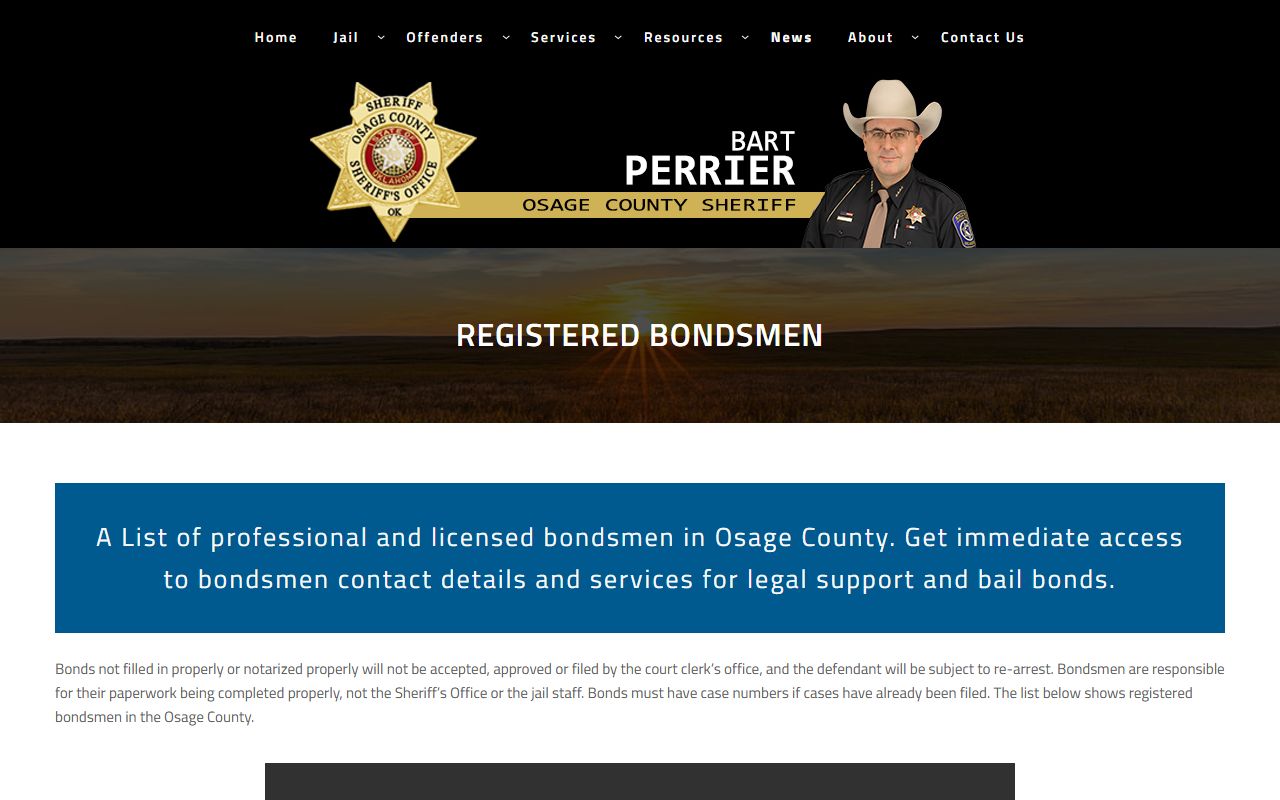
The page warns that bond paperwork must be completed and notarized correctly and must include the case number once a case has been filed, which ties the bond directly back to the charge record.
Charges vs. Convictions
A charge is an accusation, not a finding of guilt. Being charged means the state believes there is probable cause to proceed. A conviction comes only after a guilty plea, a no-contest plea accepted by the court, or a verdict. The charge record can exist long before any outcome, so the two should never be read as the same thing.
| Charge | Conviction | |
|---|---|---|
| Stage | Accusation | Verdict or plea |
| Burden of Proof | Probable cause | Beyond reasonable doubt |
| Public Record | Yes | Yes |
The charge says what the state alleges. The case file later shows the disposition, which may be a plea, dismissal, conviction, acquittal, sentence, or revocation. A dismissed or acquitted charge still appears in the record, but it is not a conviction.
Sealed vs. Expunged Records
Not every charge record stays public forever. Oklahoma allows certain records to be sealed or expunged, but the two are different. Sealing hides a record from ordinary public view. Expungement goes further and treats the matter as though it never appeared in the public file. Both require a court process, not a simple request to a website.
| Sealed | Expunged | |
|---|---|---|
| Visibility | Hidden from public | Destroyed / treated as never existed |
| Law Enforcement | Limited access | Very limited |
| Eligibility | Set by statutory category under 22 O.S. 18 | Must fit a category under 22 O.S. 18(A) and obtain a court order |
The Oklahoma State Bureau of Investigation says it cannot pre-approve whether someone qualifies and points to the eligibility list in Title 22, Section 18(A). Until a court grants relief, non-expunged charges can still show on ODCR, OSCN, or the Sheriff's records. The Court Clerk handles local filing and copy logistics but cannot give legal advice.
Note: A person who wins expungement should expect the public court and criminal history systems to update only after the court order is processed through each agency.
Charge Codes and Severity Levels
Each charge is tied to a statute, and that statute fixes the severity level. Oklahoma sorts criminal offenses into felonies and misdemeanors. A felony is a serious offense that can carry prison time. A misdemeanor is a lower-level offense that usually carries shorter jail exposure and fines. City ordinance violations are handled separately in municipal court.
One arrest can produce several separate charges, and each is counted on its own. Court records label these as counts, so a single case may list count one, count two, and so on. Case prefixes echo the severity: CF marks felony proceedings and CM marks misdemeanor proceedings in the Osage County District Court index. Reading the prefix and the count list gives a quick sense of how serious the filed charges are.
Statewide Charge and Criminal History Lookups
Charges filed in Osage County roll up into broader records beyond the local docket. The court systems ODCR and OSCN are statewide, so an Osage case can be found alongside cases from other Oklahoma counties. For a formal criminal history rather than a single case, the Oklahoma State Bureau of Investigation maintains state criminal history records and runs the disposition and expungement processes. Court costs and copies still flow through the Court Clerk for certified material.
Some custody outcomes land outside the state system entirely. A person sentenced to federal prison is tracked by the Federal Bureau of Prisons, not the county jail roster. The BOP inmate locator finds sentenced federal prisoners nationwide.
Open the Federal Bureau of Prisons inmate locator when a charge moved to federal court and ended in federal custody.
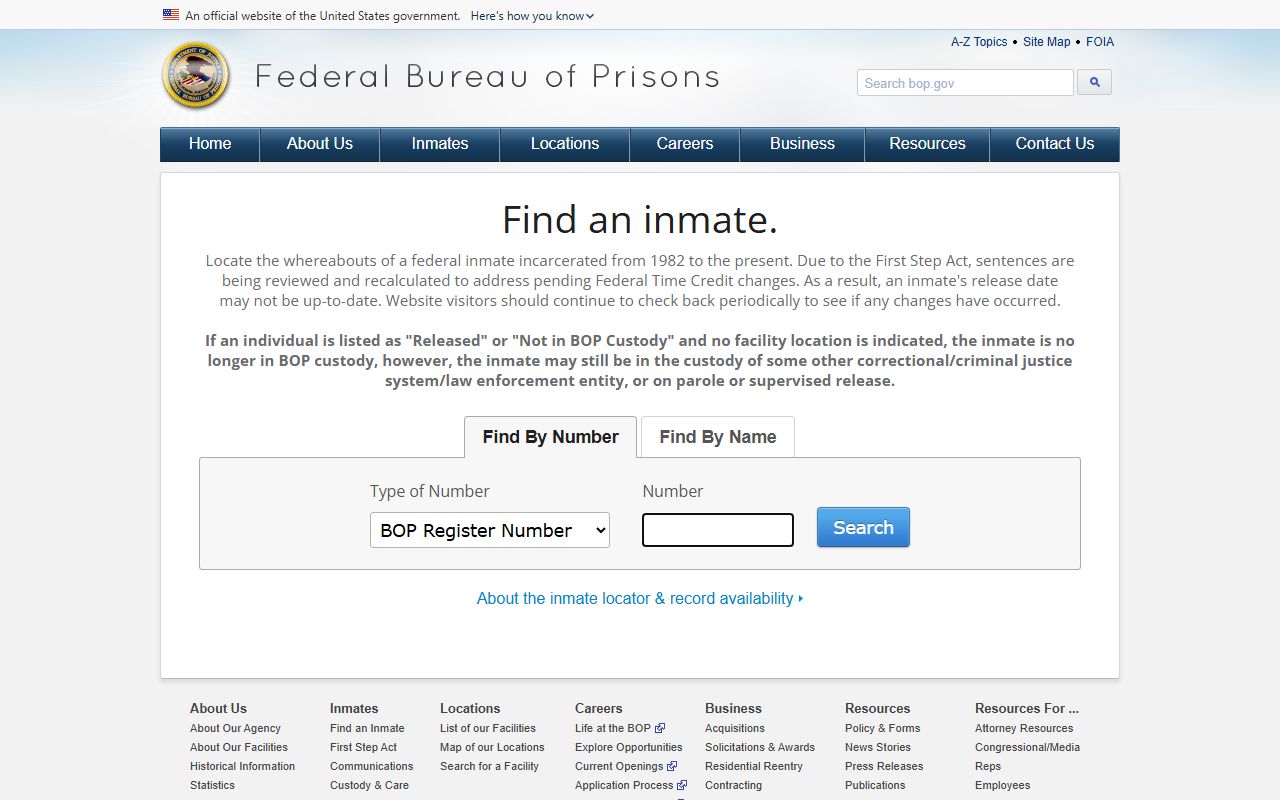
The BOP locator is separate from the Osage County jail roster, which only shows people in current county custody, so the two tools cover different stages of a charge that reaches federal court.
Federal Charges and Indian Country Jurisdiction
Not every charge from Osage County is a state charge. Osage County sits in the United States District Court for the Northern District of Oklahoma, and the county's boundaries line up with the Osage Nation reservation. That overlap means some offenses are prosecuted in federal court instead of state District Court, depending on the defendant, the victim, the offense, and federal jurisdiction rules. Federal charges follow a separate track and do not appear on ODCR or OSCN.
The federal interest in Osage County reaches civil enforcement too. The U.S. Attorney for the Northern District of Oklahoma handles federal prosecutions and major litigation tied to the county and the Osage Mineral Estate.
The Department of Justice news release on the Osage Wind case shows how federal litigation can center on Osage County.
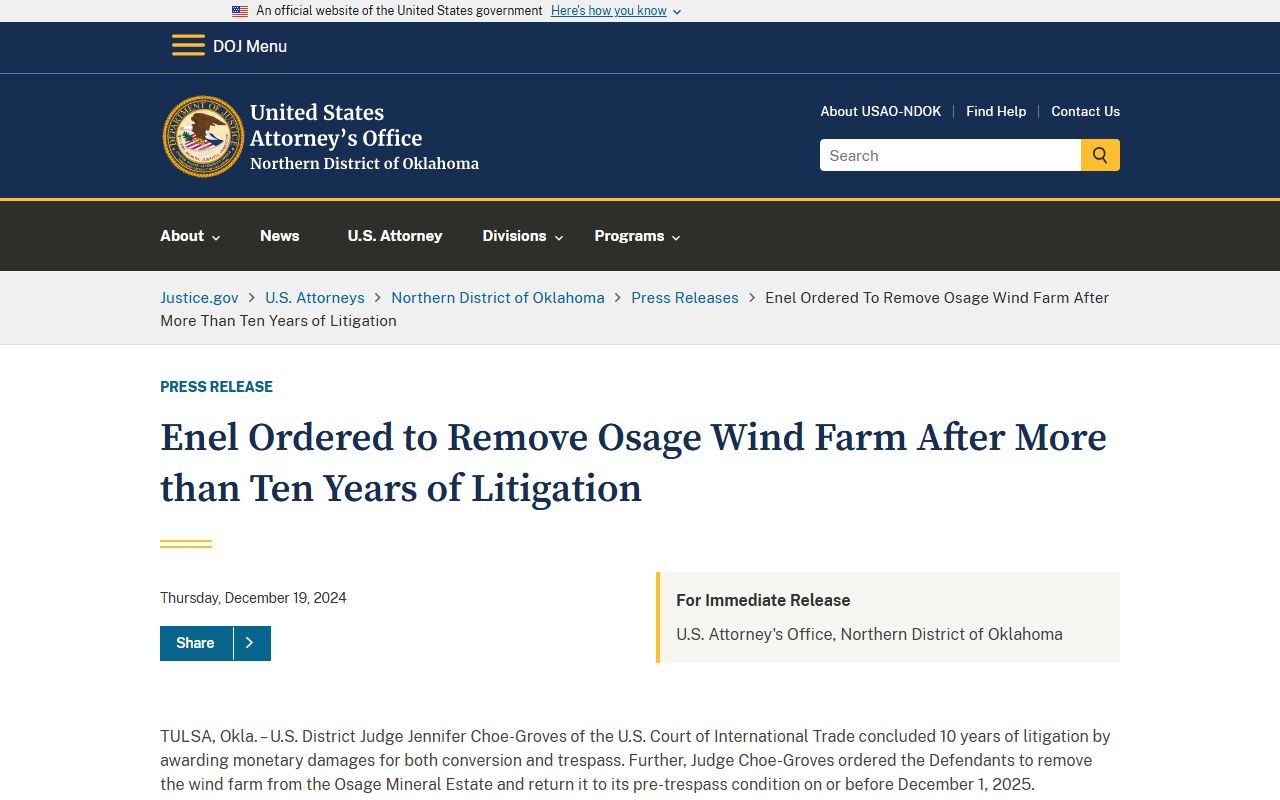
That release covers a federal order to remove a wind farm from the Osage Mineral Estate after more than ten years of litigation, a reminder that federal court is a real venue for Osage County matters and not only a backdrop.
Looking Up Federal Charges and Dockets
Federal docket access works differently from the state court search. Federal cases and the charges in them are found through the federal Public Access to Court Electronic Records system and its CM/ECF dockets, not through Oklahoma's court portals. A free option also exists for some federal material, which helps readers who do not have a paid account.
CourtListener publishes many federal opinions and some docket material at no cost, which is a useful starting point for federal charges and rulings.
CourtListener is free but not the official source, so certified copies and complete docket access stay with the federal courts. For full access, registration is required.
To pull complete federal dockets and filings tied to a charge, the official route is PACER. It charges per page but covers the entire federal docket for the Northern District of Oklahoma.
Register for PACER to reach official federal dockets and the documents filed in a federal charge.
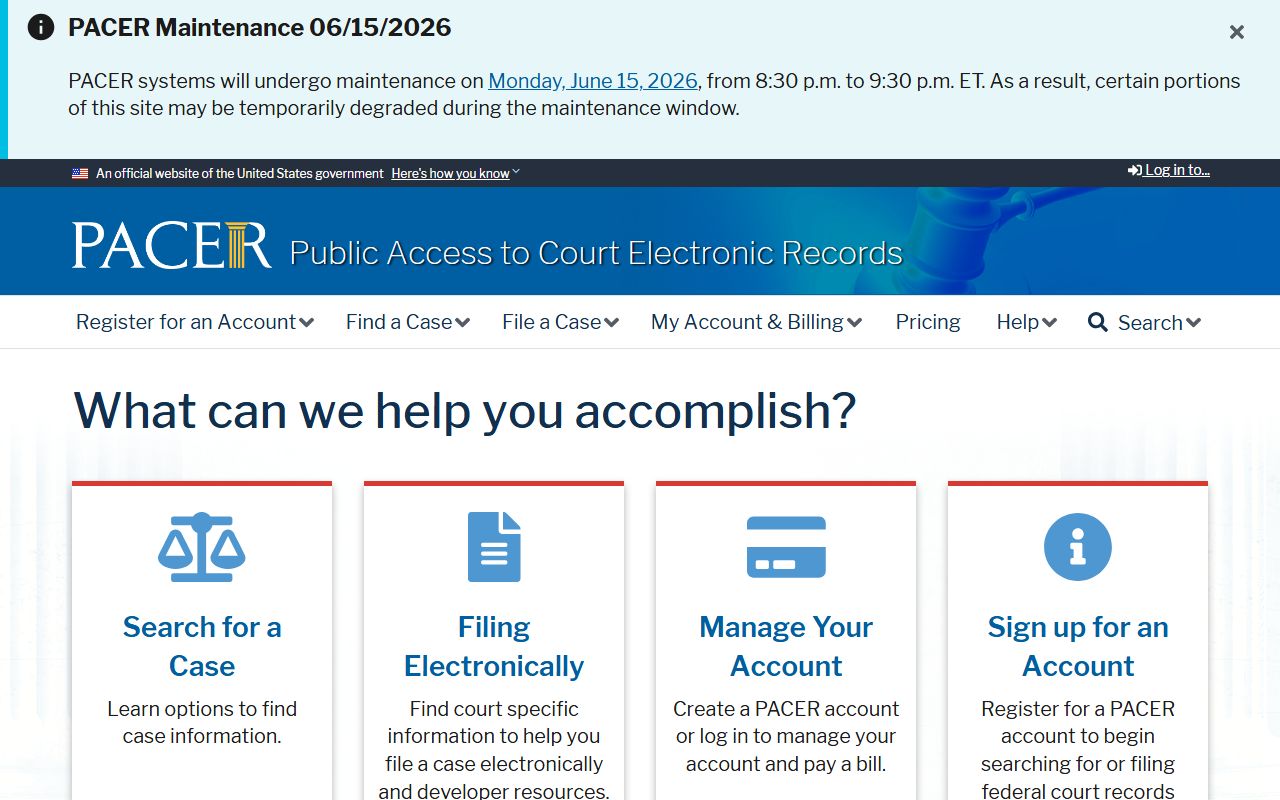
Once registered, a reader can search federal cases by party and read the charging documents and orders directly, the federal counterpart to reading a charge list on a state docket.
Holds and Fugitive Charges in Osage County
Some entries on the jail roster are not local Osage charges at all. A hold means another county, state, or agency wants the person, so the booking list may show a case number from elsewhere. A fugitive from justice listing means the person is wanted on a charge filed in another jurisdiction. These appear on the roster but trace back to a court somewhere else.
Roster charge text seen in Osage County has included out-of-county holds with their own case numbers, fugitive from justice, and a mix of local counts. To resolve where a charge actually lives, follow the case number. A local CF or CM number points to the Osage County District Court, while an outside case number points to another court that the reader will need to contact directly.
Requesting Charge and Arrest Records
Online dockets are indexes, not the full file. When a reader needs a certified charge document or an arrest report, a records request is the right channel. Court charge documents come from the Osage County Court Clerk, while arrest and incident reports come from the Sheriff's Records Division. Each office is a separate records holder with its own fees.
The Sheriff's Records Division processes open records requests for Sheriff's Office material, with posted fees of $0.25 per page for copies and reports and $1.00 per certified page. Law enforcement records can be limited where an investigation is active. For court filings, the Court Clerk in Pawhuska provides certified copies and access to older or non-online case files.
- Court charge filings and certified case copies: Osage County Court Clerk.
- Arrest, booking, and incident reports: Sheriff's Records Division.
- Federal charge documents: PACER or the federal court clerk.
- State criminal history: Oklahoma State Bureau of Investigation.
Background Check Considerations
There is a difference between a casual lookup and a regulated background check. Reading a charge on a public docket is informational. Using charge data to decide on employment, housing, credit, or insurance falls under the federal Fair Credit Reporting Act, which sets rules a court docket search does not meet on its own. Anyone making one of those decisions should use a compliant screening service.
Important: This site is not a consumer reporting agency under the FCRA, and its information may not be used for employment, tenant, credit, or insurance screening.
Restricted Charge Records in Osage County
Public access has limits. Some charge records are withheld or shown only in part, even though the case exists. Knowing which categories are restricted helps explain why a search may turn up little or nothing on certain matters.
- Juvenile and youthful offender cases, which are commonly limited to parties, attorneys, agencies, or court order.
- Sealed or expunged records, which public portals may remove or obscure after a court order.
- Adoption and mental health matters, which are sensitive and often confidential.
- Personal identifiers such as Social Security and financial account numbers, redacted under court rule.
- Active investigation details, which law enforcement may withhold for safety reasons.
The Oklahoma Open Records Act keeps most government records open, but it allows confidential categories to stay closed. Law enforcement records have their own access rules that let investigative and safety-sensitive details be held back. When a charge does not appear where it should, a restriction or a recent filing delay is often the reason, and the Court Clerk or Sheriff's Records Division can confirm which applies.