
Criminal Court Records in Osage County
A criminal court record is the case file a court opens after charges are filed against a defendant. In Osage County, the Court Clerk in Pawhuska keeps these files for the District Court. The record gathers every paper and event in the case: the charging document, bond entries, the defendant's plea, motions from both sides, hearing dates, the verdict or plea, and the sentence. It is a single running history of one prosecution, not a snapshot of an arrest. The jail roster and a court case file are two different records, and the court file is the one that holds the legal outcome.
Most adult criminal cases in the county are District Court matters. Felony cases carry a CF prefix and misdemeanor cases carry a CM prefix in the state court systems. The District Court handles felonies, misdemeanors, probable cause matters, warrants, bonds, pleas, dispositions, sentencing, and probation or revocation activity. City ordinance crimes and city traffic offenses can instead sit in a municipal court, such as the courts in Skiatook or Hominy, which run separately from the county District Court. For the underlying allegations on their own, see the Osage County court charge records, and for the wider set of civil, family, and probate files, see the broader Osage County court records.
How to Search Osage County Criminal Court Records
Two free statewide systems index Osage County criminal cases. On Demand Court Records, known as ODCR, lets the public search and view dockets at no cost for participating courts. The Oklahoma State Courts Network, known as OSCN, runs a second docket system tied to the Oklahoma Supreme Court. Both let you look up a felony or misdemeanor case by defendant name or by case number.
- Open ODCR and choose the court group for Oklahoma District Courts, or leave it on all courts if you are unsure.
- Select Osage in the court dropdown so the results stay local instead of statewide.
- Search a person by entering the party name as last name, first name, or search a case number using its prefix, such as CF for felony and CM for misdemeanor.
- Narrow the results by case type and filed-date range, which helps with common names.
- Open the case to read the docket, the charges, and the disposition, then request a certified copy from the Court Clerk if you need an official document.
OSCN offers the same case lookup plus District Court reports and daily docket options for upcoming appearances. The direct OSCN search page sometimes shows a human-verification screen. If it will not load, try ODCR instead or call the Osage County Court Clerk at 918-287-4104. Online systems show docket text and case detail, but the clerk remains the official source for certified copies, sealed or restricted files, and older records held only on paper.
Stages of a Criminal Case in Osage County
A criminal case moves through set stages, and each stage leaves its own entries on the docket. Reading those entries in order is the easiest way to understand where a case stands. The charge is filed first by the District Attorney for the State of Oklahoma. The case then advances through appearances and hearings until the court reaches a disposition and, where there is a conviction, a sentence.
Case flow: Charges Filed › Arraignment › Pretrial / Motions › Plea or Trial › Disposition › Sentencing
| Stage | What Happens |
|---|---|
| Arraignment | The first formal appearance. The court reads the charges, advises the defendant of rights, addresses counsel, and takes an initial plea. |
| Pretrial / Motions | Both sides file motions, exchange information, and argue legal issues. The docket fills with continuances, orders, and hearing settings. |
| Plea or Trial | The defendant pleads guilty or no contest, or the case goes to trial before a judge or jury that decides guilt. |
| Sentencing | After a conviction, the judge sets the punishment, which may include jail or prison time, fines, court costs, restitution, or probation. |
The District Attorney and Osage County Criminal Charges
Criminal charges are not filed by police or by the courts. They are filed by the District Attorney on behalf of the State of Oklahoma. Osage County sits in District 10, which the District Attorney serves along with Pawnee County. The office prosecutes felony and misdemeanor cases, provides victim advocacy, and handles juvenile and special prosecutions that include domestic violence and drug offenses. Because the prosecutor decides what to charge, amend, reduce, or dismiss, the District Attorney's filings drive the early entries on a criminal court record.
The Oklahoma District Attorneys Council page for District 10 confirms that Mike Fisher serves Osage and Pawnee Counties and lists county payment locations for items such as bogus check, supervision, and restitution accounts.
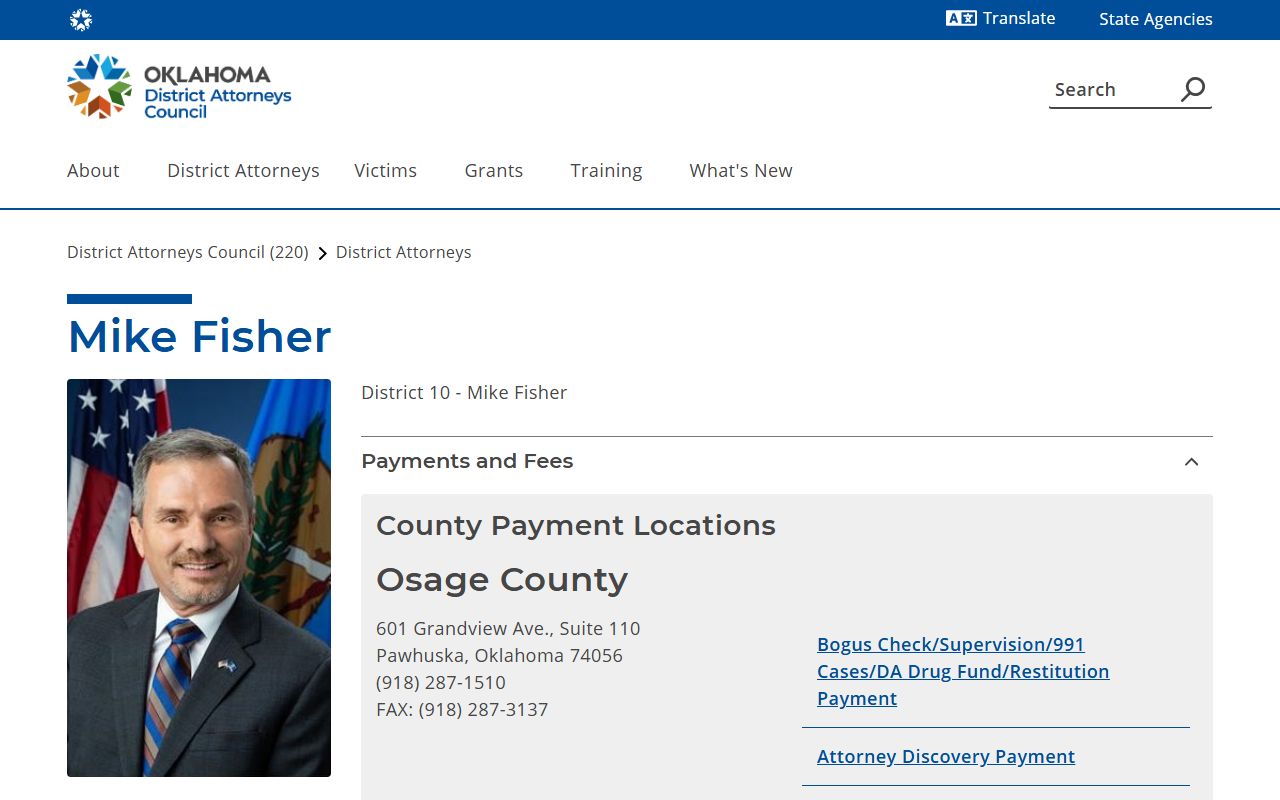
That page is useful when a record shows a charge but you want to confirm which prosecutor's office handled it and where case-related payments are made. The District Attorney's office in Pawhuska is the contact point for questions about an active prosecution.
Osage County District Attorney (District 10)
Mike Fisher, District Attorney
601 Grandview Ave., Suite 110
Pawhuska, OK 74056
918-287-1510
What an Osage County Criminal Court Record Shows
A criminal case file holds far more than a name and a charge. Each field tells part of the story, and online dockets display most of them in a single case view. Oklahoma case numbers combine a prefix, the year, and a sequential number, so a felony might read CF-2024-74 and a misdemeanor might read CM-2026-465. The fields below appear in a typical Osage County criminal court record.
| Field | What It Shows |
|---|---|
| Case Number | The prefix, year, and sequence, such as CF for a felony or CM for a misdemeanor in the District Court for Osage County. |
| Defendant | The person charged, listed against the State of Oklahoma as plaintiff. |
| Charges | Each count the State filed, with the statute or offense described and the severity level noted. |
| Plea | The defendant's response to each count, such as guilty, not guilty, or no contest. |
| Disposition | The outcome of each charge, from dismissal or acquittal to conviction. |
| Sentence | The punishment after a conviction, including incarceration, probation, fines, costs, or restitution. |
The docket also lists the assigned judge, the attorneys, the arresting agency, bond entries, hearing dates, and a running list of filings and orders. Financial lines track fines, court costs, and payment plans. Document images may be limited online, but the docket text is usually open, and the full file is available from the Court Clerk.
Reading Dispositions in a Criminal Record
The disposition is the line readers care about most, because it states how a charge ended. A single case can carry several counts, and each count can resolve differently. A few standard terms appear again and again in Osage County criminal court records, and knowing them makes a docket far easier to read.
- Disposition
- The outcome of a charge or the whole case.
- Conviction
- A guilty finding or a plea the court accepts.
- Dismissed with prejudice
- The charge is dropped and generally cannot be refiled.
- Dismissed without prejudice
- The charge is dropped but may be refiled if the law allows.
- Deferred
- Sentencing is delayed under conditions, and completing them can change the final record.
- Revocation
- An action to cancel probation or a suspended sentence after an alleged violation.
A sentence sits below the disposition. It may set prison or jail time, probation, fines, court costs, and restitution. Suspended and deferred sentences carry conditions, and the docket will show later entries if those conditions are met or broken.
Note: A disposition entry can change after sentencing if a court grants a modification, an appeal, or a later expungement order in the case.
Charges vs. Convictions
Being charged is not the same as being convicted. A charge is an accusation the State must still prove, while a conviction is a final guilty finding or accepted plea. A criminal court record can show charges that were later dropped, dismissed, or ended in acquittal, and those charges still appear in the file even when there was no conviction. Reading the disposition for each count is the only reliable way to tell the two apart.
| Charge | Conviction | |
|---|---|---|
| Stage | Accusation | Verdict or plea |
| Burden of Proof | Probable cause | Beyond reasonable doubt |
| Outcome Certain | No, still pending | Yes, case decided |
| Public Record | Yes | Yes |
Court-Appointed Defense in Criminal Cases
Defendants who cannot afford a lawyer may qualify for appointed counsel. In Osage County, the Oklahoma Indigent Defense System covers non-capital trial defense through a contract attorney rather than a county public defender's office. The contractor handles eligible cases once the court finds a defendant indigent. Appointment runs through the court's indigency process, so a defendant does not choose appointed counsel the way they would hire a private lawyer.
The Oklahoma Indigent Defense System page for Osage County coverage names Fletcher Daniels of Bartlesville as the non-capital trial contractor and lists the OIDS contact structure.
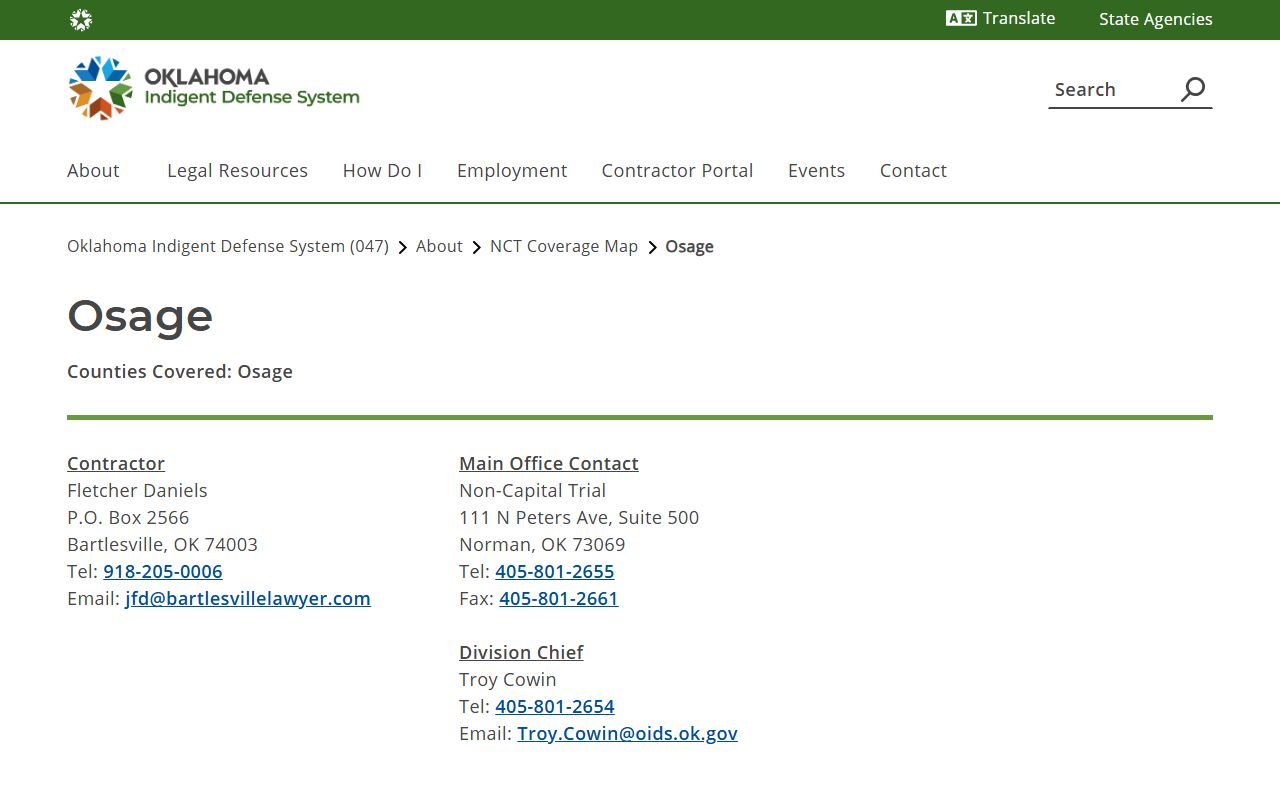
The case docket will show the defense attorney of record, whether retained or appointed, so the record itself confirms who represented the defendant at each stage.
State, Federal, and Tribal Criminal Jurisdiction
Not every crime tied to Osage County is a state District Court case. Some are prosecuted in federal court. Osage County falls within the United States District Court for the Northern District of Oklahoma, which is based in Tulsa and covers eleven counties. Federal court handles federal crimes, federal civil matters, and Indian Country prosecutions where federal jurisdiction applies. Federal cases are not in ODCR or OSCN. They are found through PACER and the federal CM/ECF system instead.
The boundary matters in Osage County more than in most places. The county lines match the Osage Nation reservation boundaries, and Indian Country jurisdiction has been a major legal question across northeastern Oklahoma. Whether a matter is charged in state District Court or in federal court can depend on the offense and on the status of the people involved. The U.S. Attorney's Office for the Northern District of Oklahoma prosecutes federal crimes for the region.
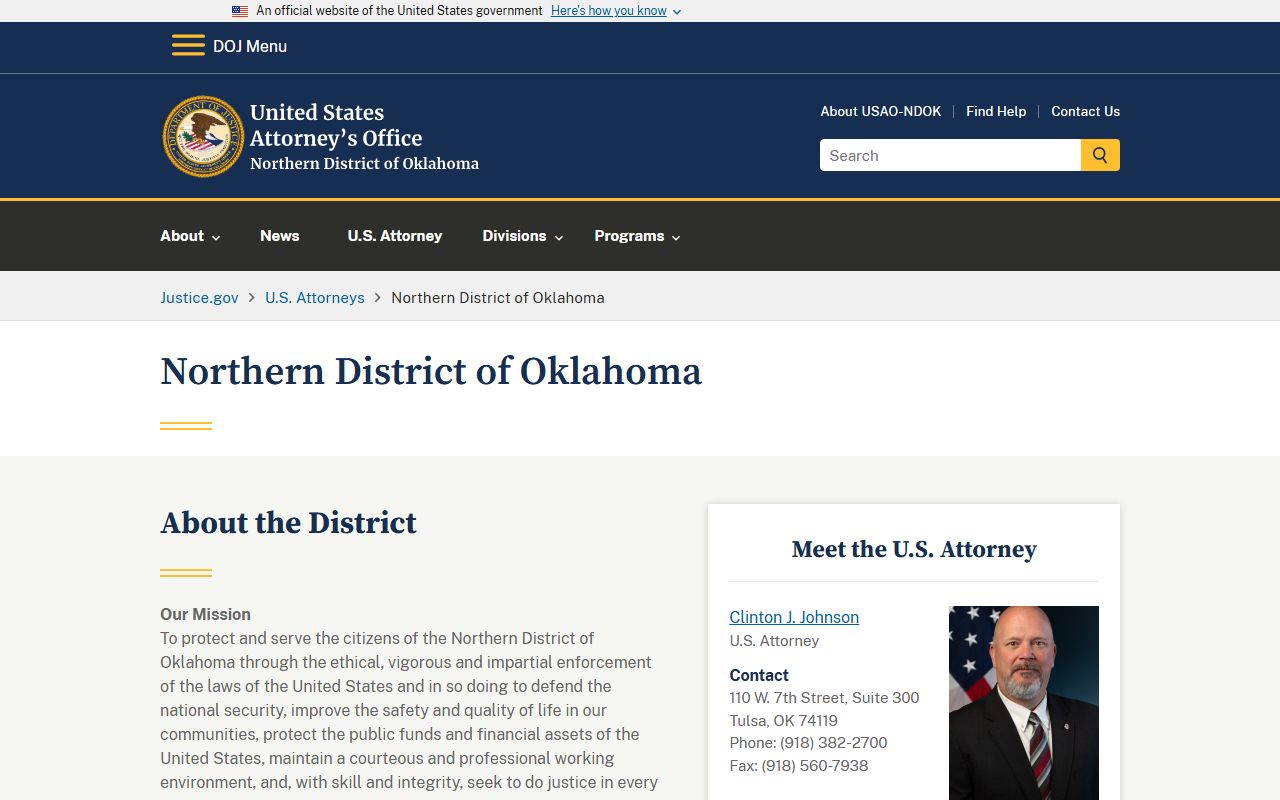
That office handles the federal side of cases that the county District Court does not. The same office publishes an about page for the Northern District that confirms which counties it serves.
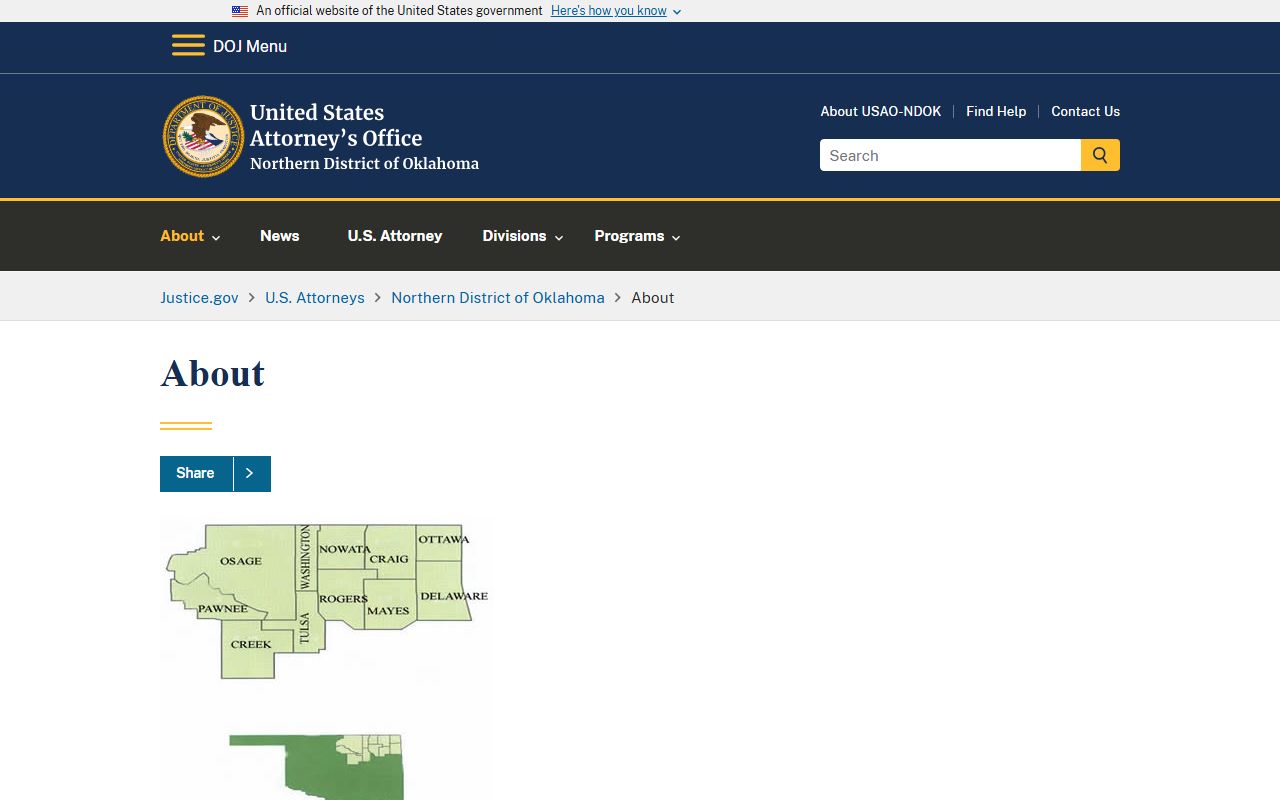
That page lists all eleven counties in the district and names Osage among them, which confirms that federal criminal matters from the county are handled in Tulsa, not in Pawhuska. The U.S. Marshals Service for the district also lists court locations that include Pawhuska.
Sealed vs. Expunged Criminal Records in Osage County
Sealing and expungement are not the same thing, and people often mix them up. A sealed record is hidden from the public but still exists. An expunged record is treated as though it never happened. Oklahoma expungement runs under Title 22, and a person must fit a statutory category, file in the proper court, give notice to the agencies involved, and obtain a court order. Until a court grants relief, non-expunged cases can still appear on ODCR and OSCN.
| Sealed | Expunged | |
|---|---|---|
| Visibility | Hidden from public | Destroyed or treated as never existed |
| Law Enforcement | Limited access | Very limited access |
| Eligibility | Set by court order under Oklahoma law | Statutory categories under 22 O.S. 18(A) |
Important: The Oklahoma State Bureau of Investigation states it cannot pre-approve whether a person qualifies for expungement, and it points eligibility to the categories listed in 22 O.S. 18(A).
Public Access to Osage County Criminal Court Records
Oklahoma treats court records as public unless a law makes them confidential. Criminal case files in the District Court are open for inspection during business hours, and the public docket systems put much of that detail online for free. The practical route is to search ODCR or OSCN, read the docket, and then contact the Court Clerk for certified copies or for files that are not online. Certified copies for legal use come from the clerk, not from the online portals.
Key Statutes:
Oklahoma Code § 51-24A.5 - Public records of public bodies are open for inspection and copying during regular business hours unless a law makes them confidential.
Oklahoma Code § 51-24A.8 - Law-enforcement records carry public-access rules, but some investigative or safety-sensitive details may be withheld.
Criminal Records and Background Checks
People use criminal court records for many reasons, from following a local case to checking a name out of caution. There is a real difference between a casual public-record lookup and a formal background check used for hiring or housing. Formal screening for those purposes is regulated by the Fair Credit Reporting Act and must run through a compliant consumer reporting agency. A public docket search on ODCR or OSCN is not such a report.
Important: This site is a public-record resource and is not a consumer reporting agency under the FCRA, so its information may not be used to make credit, employment, tenant, or insurance decisions.
Restricted Osage County Criminal Court Records
Some criminal matters are not fully open to the public. Juvenile cases are maintained by the Court Clerk but are commonly restricted, with access often limited to parties, attorneys, agencies, or those holding a court order. Youthful offender cases can also carry tighter access than ordinary adult criminal files. Mental health and certain treatment-court matters may be confidential as well.
Sealed and expunged cases drop out of the public portals once a court order takes effect, and personal identifiers such as Social Security numbers and financial account information are redacted under Oklahoma court rules. Sealed details, active investigations, and warrants before service may also be withheld. When a search turns up nothing, the record may be restricted, the case may sit in a municipal court, or the matter may be a federal case in the Northern District. Active warrants tied to a case are tracked separately through the Sheriff's Office warrant system rather than the District Court docket.
Note: A blank result on ODCR or OSCN does not always mean no record exists, since restricted, sealed, municipal, and federal cases are kept in separate systems.