
What Osage County Probate Covers
Probate is the court process that settles what a person owns and owes after death. It proves whether a valid will exists, names someone to manage the estate, pays creditors, and transfers what is left to the heirs. In Osage County, probate is handled in the Probate Division of the District Court in Pawhuska, not a stand-alone probate courthouse. The Osage County Court Clerk keeps these case files alongside the county's civil, criminal, family, and small claims records.
The same division also handles guardianships and conservatorships, which protect people rather than estates of the dead. A guardianship can cover a minor child or an incapacitated adult, while a conservatorship focuses on managing money and property. Oklahoma probate, estate administration, and small-estate rules sit in Title 58 of the state statutes, and you can read the text in the 58 O.S. probate statutes.
Common matters in this division include the following:
- Wills, filing of wills, and probate of a will or an intestate estate.
- Appointment of a personal representative and issuance of letters.
- Inventory, appraisement, and creditor notices.
- Sale or transfer of estate property.
- Guardianship of minors or incapacitated adults.
- Conservatorship and trust proceedings filed in court.
- Final accounting and distribution of the estate.
Probate Terms Defined
Probate paperwork uses words that rarely come up anywhere else. A quick read of the core terms makes a docket far easier to follow before you open a case file.
- Testator
- The person who made the will. The will speaks for the testator after death.
- Executor
- The person a will names to carry out its instructions and settle the estate.
- Intestate
- Dying without a valid will, so state law decides who inherits.
- Letters testamentary
- The court order that gives an executor legal authority to act for the estate.
- Guardianship
- A court arrangement giving one person legal care over a minor or an incapacitated adult.
- Conservatorship
- Court-supervised management of another person's money and property when they cannot handle it alone.
How to Search Osage County Probate Records
Probate files are public court records, so the fastest route is the same statewide search ecosystem used for other District Court cases. Start with On Demand Court Records, then cross-check the state docket system if you need it. Probate cases carry the PB prefix, and related matters appear under guardianship, conservatorship, trust, and filing-of-wills case types.
The Oklahoma Bar Association publishes a plain-language overview of how probate works statewide, which pairs well with a county search. You can read its free legal information on probate before opening a case file.
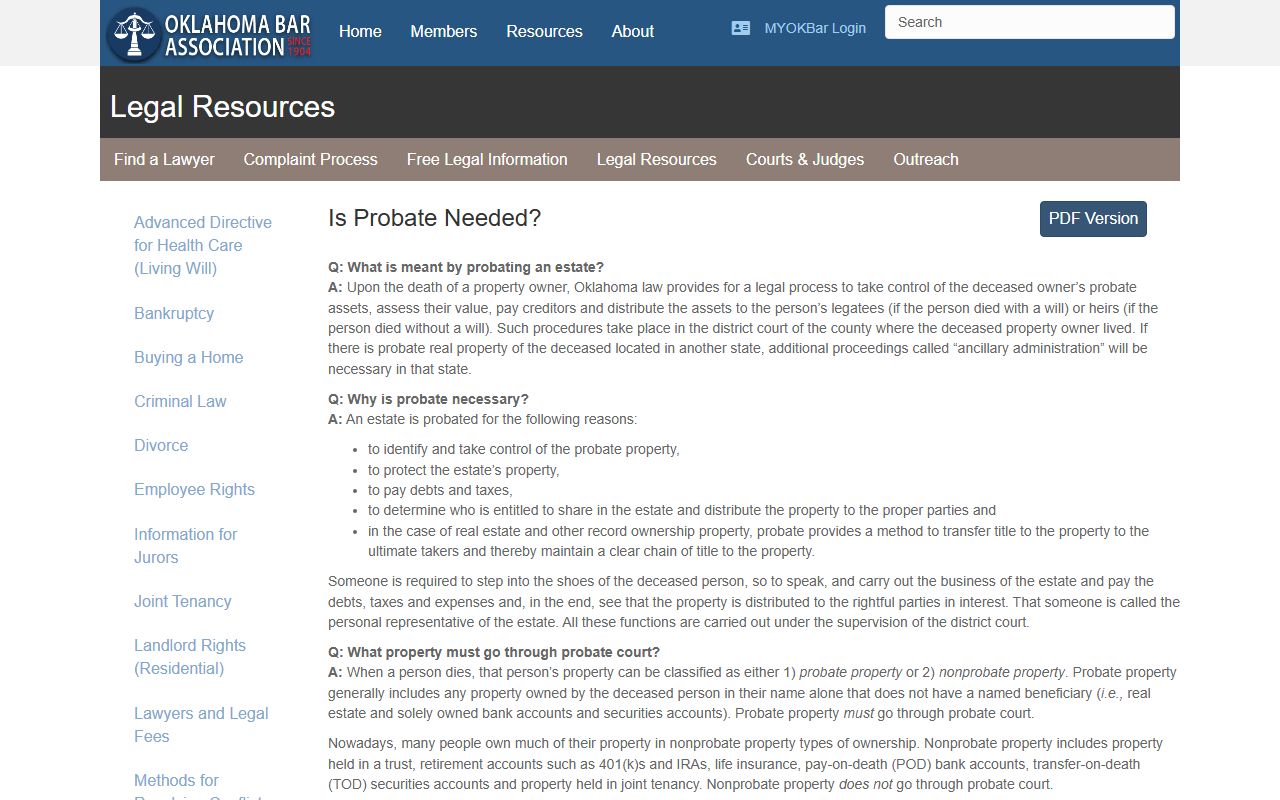
That Bar Association page explains terms and timelines that the docket itself never spells out, which makes the entries you find in an Osage County probate search easier to read. To run a search:
- Open On Demand Court Records (ODCR) and choose the court group for Oklahoma District Courts.
- Select Osage in the court dropdown so results stay local instead of statewide.
- Enter the decedent's or party's name as Last, First, or type the full case number if you have it.
- Add a case type of Probate Proceedings, Guardianships, or Conservatorship only when you know the record type.
- Use a filed-date range to narrow common names, then open the matching PB case to read the docket.
- If a result does not load, try the Oklahoma State Courts Network (OSCN) docket search or call the Court Clerk.
Note: ODCR public court record searching and docket viewing are free, as stated on the ODCR pricing page, with paid plans only for added services.
Osage County Probate Division Contact
The Probate Division is part of the Osage County District Court, and the Court Clerk is the office that maintains and releases probate case files. Use this contact for in-person visits, phone questions, certified copies, and requests for older or non-digitized probate files. District Judge Stuart Tate, Associate District Judge Burl Estes, and Special Judge Cindy Pickerill hear matters in this courthouse.
Osage County Court Clerk (Probate Division of the District Court)
600 Grandview, Room 304
Pawhuska, OK 74056
918-287-4104
Monday to Friday, 8:30 a.m. to 5:00 p.m.; closed noon to 1:00 p.m.
Court Clerk Lavendar Carroll leads the office, with Heidi Kastning as 1st Deputy. The same counter handles marriage licenses and other District Court filings, so a probate visit can cover several record needs at once.
How Probate Works in Osage County
Most estates follow a predictable path once a case opens. The steps below show how a typical Osage County probate moves from start to close. Timing and exact filings vary with the size of the estate and whether anyone contests it.
- Decide whether probate is needed. If only qualifying personal property under the state small-estate threshold is involved, an affidavit may be enough.
- If court probate is required, file in the Osage County District Court through the Court Clerk.
- Search ODCR for any existing PB case using the decedent's name and the Osage court so you do not duplicate a filing.
- The court may appoint a personal representative and issue letters that grant authority over the estate.
- Required notices, inventories, creditor handling, property sales or transfers, and accountings proceed under Oklahoma probate rules.
- Once the court approves the final accounting and distribution, the case can close.
A surviving spouse or heir often interacts with several offices during this process. Divorce decrees and prior marriage records, for example, may matter when proving heirs, and those live with the Court Clerk too. You can read more about Osage County marriage and divorce records if a probate case turns on family history.
Small Estate Affidavit Threshold
Not every estate needs a full probate case. The Oklahoma Bar Association explains that when cumulative probate personal property, not counting real estate, is less than $50,000, successors may use a Small Estates Affidavit and skip probate for that property. This can save time and cost when an estate is modest and uncontested.
Important: A small-estate affidavit is not the same as a probate case docket, and it generally cannot transfer real estate. Real property, contested estates, creditor disputes, or unclear heirs usually still require a court probate.
Because the affidavit route avoids a court file, you will not always find a PB docket for an estate that was settled this way. If you cannot locate a probate case for someone who has died, a small-estate affidavit, a trust, or joint ownership may explain why no court file exists.
Osage County Probate Filing Fees
A specific Osage County probate filing fee was not posted on the county's official court sources beyond a general Court Clerk fee and bond schedule link. For current probate filing costs and per-page copy charges, call the Court Clerk at 918-287-4104 or check the published county schedule on the Osage County fee page. The Court Clerk is the office that quotes and collects court filing fees.
The County Clerk is a separate office that handles land and recording records, not court cases. Its posted copy and certification charges are shown below as related record-copy context, since estate matters sometimes touch deeds and transfer-on-death filings recorded there.
| Item | Amount |
|---|---|
| Probate filing fee (Court Clerk) | Call 918-287-4104 for current amount |
| County Clerk copy of photographic, typewritten, or printed record | $1 per page |
| County Clerk additional page of the same recorded instrument | $2 |
| County Clerk certifying a copy | $1 per page |
Estate planning sometimes uses deeds that pass property outside probate. The County Clerk forms page lists a Transfer-On-Death Affidavit, a Transfer-On-Death Deed, and an Affidavit of Surviving Joint Tenant, among other land-record forms. You can review the full list on the County Clerk forms page.
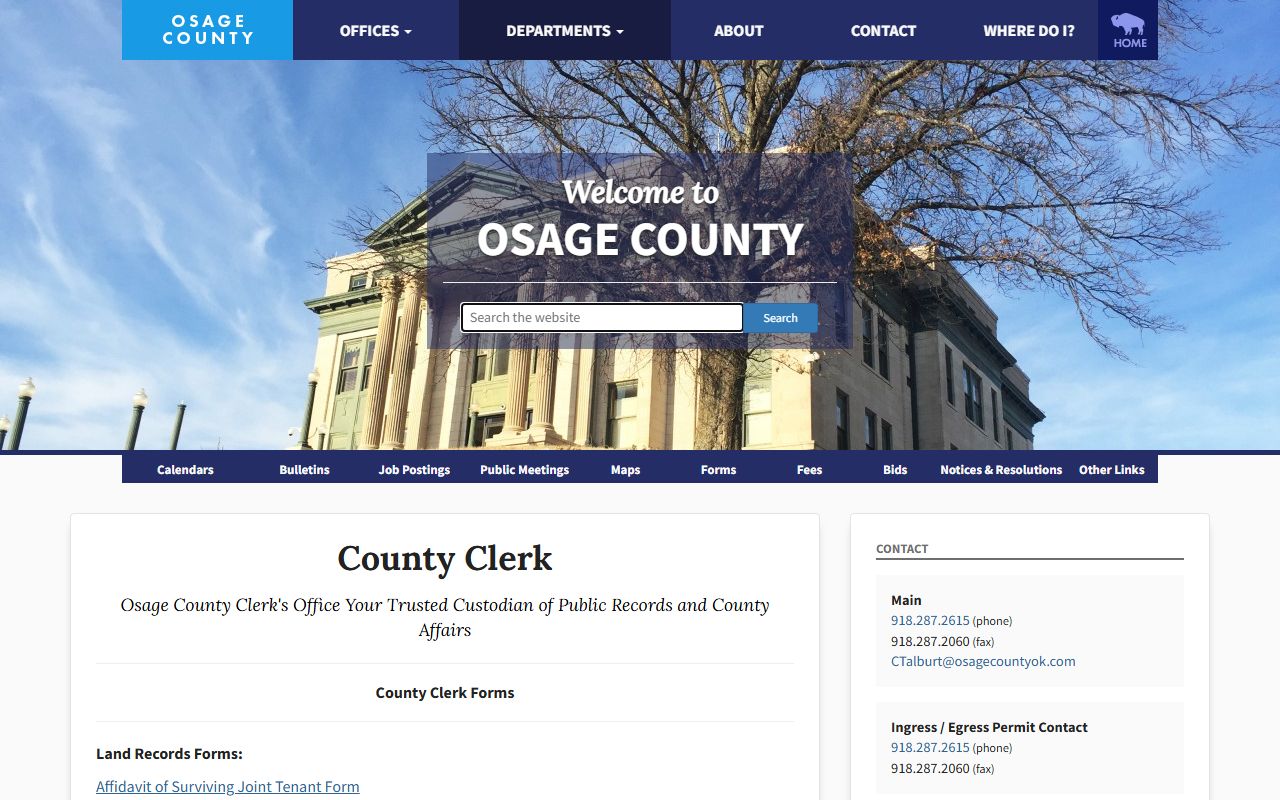
Those recorded forms sit with the County Clerk at 601 Grandview, while the probate case file itself stays with the Court Clerk in Room 304. Keeping the two offices straight prevents a wasted trip when you need an estate document.
What Osage County Probate Records Show
A probate case file builds a paper trail from the first petition to the final decree. The docket lists each event in order, and the underlying documents fill in the detail. The table below outlines the fields you can expect to see in an Osage County probate or estate record.
| Field | What It Shows |
|---|---|
| Case number | Usually a PB prefix with the filing year and a sequential number. |
| Decedent or estate name | The person whose estate is being settled, or the protected person in a guardianship. |
| Filing date | The date the case opened, shown in MM/DD/YYYY format. |
| Petitioner or applicant | The party asking the court to open probate or appoint a representative. |
| Personal representative | The executor or administrator the court appoints to manage the estate. |
| Attorney and judge | Counsel of record and the assigned District Court judge. |
| Docket events | Petition, order setting hearing, notice, proof of publication, order admitting the will, letters, inventory, final account, and decree. |
Online systems usually show the docket text for free, but the actual documents may be limited or available only from the clerk. For a certified copy of a will, letters, or a final decree, request the file from the Court Clerk in person, by phone, or by mail. Certified copies carry the court's seal and are the version courts, banks, and title companies accept.
Note: Probate files are part of the broader case system, and the same public-access rules apply across the District Court records the Court Clerk maintains.
Restricted Probate and Guardianship Records
Most probate dockets are open to the public, but not every page of every file is. Guardianship and conservatorship matters often include sensitive details about a protected person's health, finances, and living situation. Access to those parts may be limited to the parties, their attorneys, involved agencies, or anyone the court specifically allows.
Mental-health material draws the tightest limits. Oklahoma court systems track mental health and Anna McBride Act case types, and commitment details can be confidential by statute or sealed by court order. Personal identifiers such as Social Security numbers, financial account numbers, and information about minors are also redacted under Oklahoma court rules on personal-identifier data.
When a record is restricted, the public docket may show that a case exists while hiding the protected content. If you are a party to a guardianship or estate and need a sealed document, ask the Court Clerk how to make the request. The clerk can explain local filing and copy logistics but cannot give legal advice. The clerk's full role is profiled on the Osage County Court Clerk page.